
Free Shipping on Most Orders
Top Down Sound, Part 4: Equalizing the audio system in a convertible

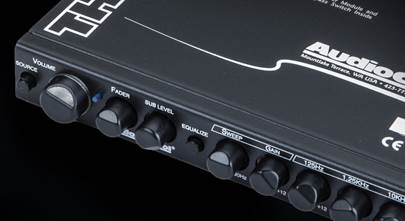
Jeff and I meet at the Crutchfield Research Bay for the final system tuneup. In the last installment, we set the crossover points and adjusted the gain structure in the Sebring's system. Now, we've borrowed an AudioControl Real Time Analyzer (RTA), a complex little box that's used to measure frequency response, so we can tune the system for more even, "flatter" response. The Eclipse receiver can actually make these measurements by itself, and it also offers an amazing menu of audio adjustments for tuning your system. Even more impressive, you can go to the Eclipse site, download info on equalizing your vehicle, and upload it into the receiver. But we elected to use the AudioControl RTA simply because it operates on the same frequency points as their DQXS equalizer, so we'll get extremely precise control over the final sound curve.

Real Time Analyzer
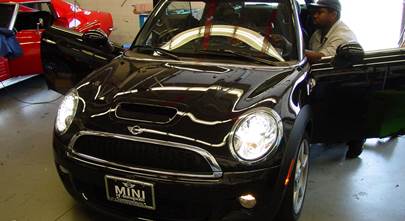
We put the top down, attach a microphone to the driver seat headrest, and set up the RTA in the trunk next to the AudioControl equalizer. Jeff slides in a test CD with pink noise, and cranks up the system. It sounds like a jet's taking off inside my car, a very loud whooshing noise. The screen on the analyzer shows a extremely jagged response curve with two or three noticeable peaks and valleys. Jeff pulls up a chair and goes to work.

Tame the dash speakers
First, he turns on the Boston 3-1/2"s in the dash all by themselves, and we see a couple of valleys and peaks on the screen, most likely caused by the crossover point in the Boston speakers and by the windshield's reflective surface. The DQXS offers 30 bands of equalization for the front channels, and Jeff starts dropping the frequencies around these peaks until we see a relatively flat line from 400 Hz (where the high-pass crossover's set) up to about 15,000 Hz. Jeff then adjusts the EQ to create a downward curve from 15,000 to 20,000 Hz, so the highs sound sweet when you turn the system up loud.

Bass bump in the 6"x9"s
Jeff then puts pink noise through the 6"x9"s in the doors all by themselves, and creates a similar curve starting at 80 Hz (where the high-pass is set). He accentuates the bass from 80 Hz up to around 175 Hz, boosting it about 3 dB so the door speakers will have enough low-end punch to fool your ears into thinking that the bass is coming from up front. He also duplicates the high-frequency drop from 15,000 Hz on up.

Breaking the rules with 8" subs
Next, he turns off the full-range speakers, and cranks up the 8" subwoofers. He brings the bass up about 3 dB over "flat," starting at 20 Hz and continuing all the way up to 180 Hz where it tails away. Most car audio people will tell you that your subs shouldn't handle anything much above 100 Hz. Bass becomes directional above 100 Hz, so your ears can tell that there's a subwoofer behind you. But Jeff feels that I'll need every bit of that upper bass when the top is down, and he figures that the bass kick coming from the 6"x9"s in the doors will help bring the bass forward.

Put it all together
Next, Jeff turns all three channels up - front (dash) speakers, rear (door) speakers, and the subs. On the RTA's readout, we're still seeing a slightly jagged line caused by the combined output of all the speakers. Jeff spends a few minutes tweaking out the last few peaks. Now, we're looking at the desired "waterfall" curve, with a 3 dB boost from 20 up to about 180, dropping down to flat response from 200 Hz up to around 15,000 Hz, then slowly tailing off all the way up to 20,000 Hz.

I thought my system sounded great before we went through this process, but now we've eliminated all spikes in frequency response, which means I can crank the system up louder without any hot spots that jump out and sting your ears. Last week I'd played a Toots and The Maytals disc in my car, and I'd turned down the volume because Toots Hibbert's voice was hurting my ears a little. I put that same disc in the Eclipse, turn up the system to my normal listening level, and play the same cut.

Testing out the system
First, I'm amazed at the difference in the sound. The bass is much fatter, the high frequencies are much smoother, and the mids are less strident, so Toots' voice fits perfectly in the mix now. Second, I can turn the system up much louder and the music still stays clean and focused. Jeff puts in a disc he's made for testing out systems. The first cut features a cello, and when I hear the sound of bow on string, any doubts that I may have had about using coaxial speakers instead of components disappear. The Bostons sound absolutely great, and I'm getting the same feeling I get when I listen to a great home stereo system.

We hit the highway for the ultimate test. How will the system sound with the top down at 60 mph? I put in some Buddy Guy, and bring up the volume. The wind is blowing, other cars are passing, but the music sounds clear and powerful, and Buddy's guitar is totally crushing without hurting my ears at all. The kick drum and bass guitar sound huge, and you can clearly hear all the other players in Buddy's band. This is way, way more than I'd hoped for, and it makes me laugh out loud.

We put the top up to see how the system sounds when it's closed in. The bass is overpowering, but I drop the sub level control on the Eclipse down three clicks and everything sounds great. My next project will be to install the dash-mount controller for the AudioControl digital equalizer in the spot currently occupied by my factory CD changer. That way, I can experiment with EQ settings without having to go to the trunk.

Three weeks down the road
I've driven around for a couple of weeks now with the new system, and I've taken a couple of long road trips. I've found that the most impressive thing about this system is that it's so accurate and clean. The 8" subwoofers respond more quickly than larger subs, so the bass stays really tight and punchy, just like you'd hear through good home speakers. Electric guitars are plenty bright, but they never sound brittle. The Boston amp has the headroom to reproduce big dynamic changes, so when the drummer hits a floor toom, it really sounds like a floor tom.

The other thing I've noticed about this system is that it's not very forgiving - it will not make a bad recording sound good. You can really hear the deficiencies in poorly mixed or mastered discs. For instance, I hear a dramatic difference between original CD releases done in the 80s and 90s and sonically superior remastered releases done more recently. This accuracy has been a big plus for my band as we continue to work on tracks from our latest CD. This system really shows us when something's wrong in a mix, even more so than on my home system.

A car interior is an intimate little place, where music can have incredible impact. I've listened to more music in the last month than I have in a long, long time, and that's what it's all about. Bless all of you car audio manufacturers, because you just made my life a little bit better.


Check out the video "Tuning a High-end Car Stereo System."


Posted Wed, May 27 2009 1:23 PM by Charlie

Comments

Jordan wrote re: Top Down Sound, Part 4: Equalizing the audio system in a convertible
on Sun, Jun 14 2009 11:46 PM

How much for the real time analyzer? can i borrow one... i have about $4,000 in car audio but still cant manage to get rid of high pitch spikes that make me turn the volume down :(

Anonymous wrote re: Top Down Sound, Part 4: Equalizing the audio system in a convertible
on Mon, Jun 15 2009 10:54 AM

Did Jeff mention that the theory "smaller subwoofers respond more quickly than larger subs" is a myth?  There are some outstanding white papers on this topic out there which include objective, and not subjective, testing results.  

Charlie wrote re: Top Down Sound, Part 4: Equalizing the audio system in a convertible
on Mon, Jun 15 2009 11:24 AM

Hey Jordan: I think AudioControl's goes for around $1600, but you can find other ways to do this. If you live in an area with a pro car sound shop, you can pay them to tune up your system, totally worth it if you've got 4 grand in your system. Or see if you can find a local car audio enthusiast with an RTA who might help you out.  If that doesn't work for you, make friends with the sound man for a local band, and talk him or her into adjusting your equalizer to kill those spikes. Charlie

Charlie wrote re: Top Down Sound, Part 4: Equalizing the audio system in a convertible
on Mon, Jun 15 2009 12:11 PM

Anonymous: Most bass players prefer a 4x10" cabinet to a single 15" because the 10" speakers are much more responsive. I don't know about white papers, but who are you gonna trust when it comes to bass -- a bassist or some scientist?

Wade wrote re: Top Down Sound, Part 4: Equalizing the audio system in a convertible
on Mon, Jun 15 2009 8:42 PM

I'm willing to bet the "speed" those bass players attribute to the multiple smaller drivers is attributed to having roughly double the overall cone area (in a 4x10" vs 1x15"), and since bass guitars have harmonics that reach well into the kilohertz range. Since smaller drivers tend to play higher frequencies better, they'd be more suitable. Since Jeff didn't cross over the sub until 180hz - beyond subbass range - it makes sense to use a smaller driver there as well.

H Hogarth wrote re: Top Down Sound, Part 4: Equalizing the audio system in a convertible
on Tue, Jun 16 2009 9:53 AM

I had a 1999 Corvette Convertable with a Bose system ..the only way I could EVER get bass with the top down was to build a custom Box that fit below the retracted top amd two Tens with 500 Watt Bass AMP.  

Tony Gamez wrote re: Top Down Sound, Part 4: Equalizing the audio system in a convertible
on Wed, Jul 1 2009 12:41 PM

Great article, Charlie. Keep up the great reporting.

Do you know where in Houston, TX I can find some one as thorough as Jeff to equalize my system and how much I should expect to pay?

Charlie wrote re: Top Down Sound, Part 4: Equalizing the audio system in a convertible
on Fri, Jul 24 2009 3:49 PM

Tony: I can't tell you much about Houston, but you can look in the Yellow Pages under "Automobile: Sound Systems" or something similar. You can also find a good installation place near you and talk to them about their charges.

Remember, you'll need an equalizer to do this. If you don't have a receiver with a good built-in EQ, then you'll have to buy an outboard unit. I'm really impressed by the AudioControl that I've got, but there are lots of good ones out there.

Add a Comment

(optional)  
(optional)
(required)  
Remember Me?